Two pages can target the same keyword with equally good writing, and one will rank while the other barely registers. More often than not, the difference is not quality. It’s fit. One page gives searchers the kind of result they wanted; the other answers a question nobody was asking.
That fit is search intent, and getting it right is one of the most reliable wins in on-page SEO. This guide covers the four main types, the cases that don’t fit neatly into any of them, and a practical process for matching new and existing pages to what searchers actually want.
What Is Search Intent?
Search intent is the goal behind a search query: what the person typing it wants to know, find or do. Someone searching “what is on-page SEO” wants an explanation. Someone searching “on-page SEO services Dubai” wants a provider. Same topic, different goals, and different pages deserve to rank for each.
Search Intent, Keyword Intent and User Intent: What’s the Difference?
These terms overlap, and most people use them interchangeably. There is a useful distinction, though:
- User intent describes the person: their underlying goal, which may span several searches. In user intent SEO, you think about the whole journey from first question to final decision.
- Search intent describes a single query and the kind of result that satisfies it.
- Keyword intent is the label you assign to a keyword in your research, usually one of the four types covered below, so you can plan which page should target it.
In practice, keyword intent is your best estimate of search intent, and the SERP is where you check whether that estimate is right.
Why Google Cares About Intent
Google’s business depends on returning results that satisfy people quickly. Its Search Quality Rater Guidelines, which human raters use to evaluate results, sort queries into intent categories: Know (find information), Do (accomplish something, such as buying or downloading), Website (reach a specific site or page) and Visit-in-person (find a physical place). Raters judge whether a result meets the needs of the query, and a well-written page that serves the wrong intent is rated poorly.
Rater scores don’t directly change rankings, but they show what Google’s systems are designed to reward. That is why intent is treated as a foundation of on-page SEO rather than a finishing touch.
The Four Types of Search Intent
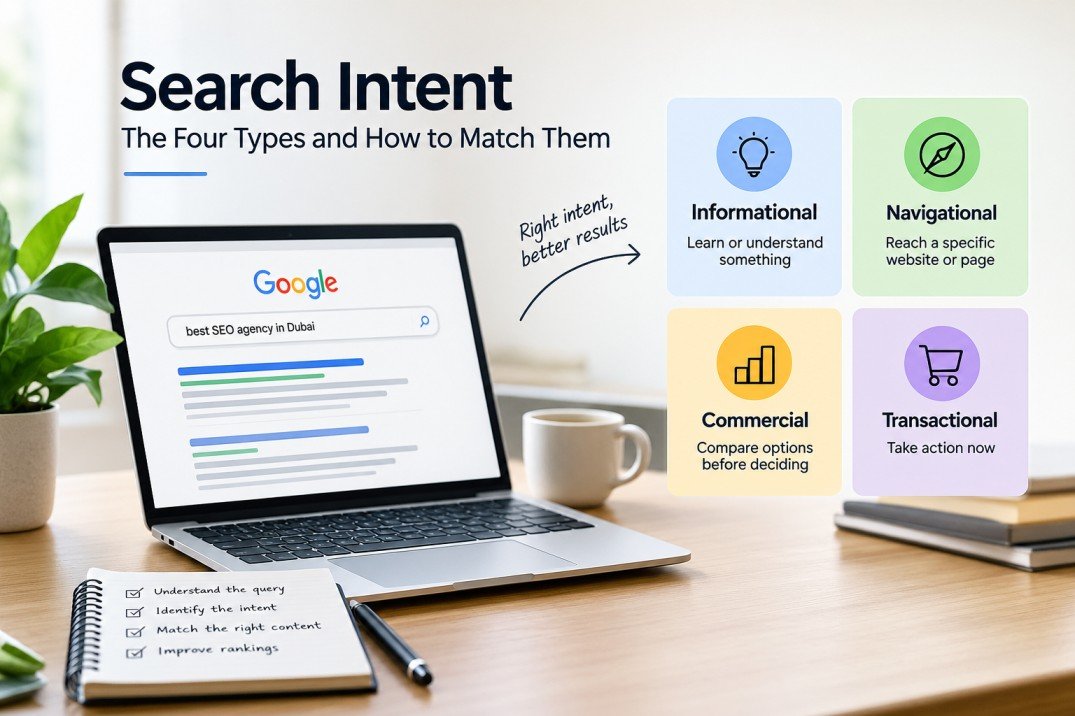
Most SEO practitioners use four categories. They map loosely onto Google’s rater categories and onto the stages of a typical marketing funnel.
Informational Intent
The searcher wants to learn something. Queries often start with “what”, “how”, “why” or “guide”, but many don’t: a search for “hreflang” alone is still a request for an explanation.
Typical examples: “what is schema markup”, “how long does SEO take”, “title tag length”. Pages that rank are usually guides, explainers, tutorials or definitions. A service page rarely ranks here, because it doesn’t answer the question.
Navigational Intent
The searcher wants a specific website or page and is using Google as a shortcut. Queries include brand or product names: “One Conversion”, “Google Search Console login”, “Semrush pricing”.
You can only realistically rank for navigational queries about your own brand. The priority is making sure your homepage, key service pages and contact details are the obvious results, with clear title tags and sitelink-friendly navigation.
Commercial Intent
The searcher is researching before a decision. They know roughly what they need but are comparing options. Common modifiers include “best”, “top”, “vs”, “review”, “comparison” and “alternatives”: “best SEO agency in Dubai”, “in-house vs agency SEO”, “Ahrefs vs Semrush”.
Rankings here tend to go to comparison articles, reviews, “best of” lists and detailed service pages that help people evaluate. This is where trust signals such as case studies, pricing clarity and process explanations matter most.
Transactional Intent
The searcher is ready to act: buy, book, sign up, request a quote or download. Modifiers include “buy”, “price”, “quote”, “hire”, “book” and “near me”: “on-page SEO audit price”, “hire SEO consultant Dubai”.
Product pages, service pages, pricing pages and booking forms rank here. A blog post, however thorough, usually won’t, because it adds a step between the searcher and the action they want to take.
The Four Types at a Glance
| Intent type | Searcher’s goal | Example queries | Content that tends to rank |
|---|---|---|---|
| Informational | Learn or understand | what is schema markup; how to do keyword research | Guides, explainers, tutorials, definitions |
| Navigational | Reach a specific site or page | One Conversion contact; Search Console login | Homepage, brand pages, login or contact pages |
| Commercial | Compare options before deciding | best SEO agency Dubai; Ahrefs vs Semrush | Comparisons, reviews, “best” lists, detailed service pages |
| Transactional | Act now: buy, book, enquire | SEO audit price; hire SEO consultant | Service, product, pricing and booking pages |
Beyond the Four: Mixed, Local and Shifting Intent
The four-type model is a useful shorthand, but real queries don’t always sit neatly inside it. Three situations come up constantly.
Mixed Intent
Some queries serve more than one goal. A search for “SEO audit” might come from someone who wants to learn how to run one, someone looking for a free tool and someone who wants to hire an agency. Google often responds with a blended results page: a couple of guides, a tool or two and a few service pages.
When you see that mix, don’t try to cover every angle on one page. Pick the intent your business can serve best, check that pages of that type already rank, and build the best version of that page. Target the other intents with separate pages if they are worth pursuing.
Local Intent
Local intent overlaps with Google’s Visit-in-person category: the searcher wants something nearby. It can be explicit (“SEO agency in Dubai Marina”) or implied (“dentist”, which Google treats as local by default). A map pack at the top of the results is the clearest sign.
For UAE businesses, local intent often plays out across emirates and languages. Someone in Abu Dhabi may see different results from someone in Dubai for the same query, and Arabic and English versions of a query can surface different SERPs. Check results for each location and language you care about rather than assuming one SERP applies everywhere.
Intent That Changes Over Time
Search intent is not fixed. A product name might be navigational most of the year and commercial around a launch or a sales event. News events can flip a query from informational to news-led overnight. Seasonal periods such as Ramadan, White Friday or the Dubai Shopping Festival can shift local shopping queries towards offers and opening hours.
Re-check the SERPs for your priority keywords periodically. If the ranking pages change type, your content may need to change with them.
How to Identify Search Intent From the SERP
Keyword tools label intent automatically, and those labels are a helpful first pass. But the most reliable source is the search results page itself, because it shows what Google has learned satisfies people. Search the keyword in a private window, set to the location you’re targeting, and look at three things.
[H3] Study the Top Results: Type, Format and Angle
Ahrefs popularised a simple framework for this, often called the three Cs:
- Content type: are the top results blog posts, service pages, product pages, category pages, tools or videos?
- Content format: within that type, are they how-to guides, listicles, comparisons, definitions or templates?
- Content angle: what hook do they share? “For beginners”, “in 2026”, “step by step”, “for small businesses”, “in the UAE”.
If eight of the top ten results are the same type and format, the intent is clear. If they are split, you’re probably looking at mixed intent.
Read the SERP Features
The features Google shows around the organic results are strong intent signals:
- Featured snippets and People Also Ask point to informational intent and show the specific questions people want answered.
- AI Overviews usually appear on informational and research-style queries.
- A local pack with a map signals local intent.
- Shopping results and product ads signal transactional or commercial intent.
- Video results suggest that people want to watch a demonstration.
- Sitelinks under a single brand suggest navigational intent.
Use Query Modifiers as a Hint, Not a Rule
Words like “how”, “best”, “price” and “near me” are useful clues, and they make it quick to sort large keyword lists. But they can mislead. “Best way to structure a website” contains “best” and is informational. Always confirm your keyword intent labels against the live SERP before committing a page to them.
How to Match Your Content to Search Intent
Once you know what the searcher wants, matching it is a series of deliberate choices:
- Choose the right page type. If service pages rank, write a service page. If guides rank, write a guide. This single decision matters more than anything else on the list.
- Match the format. Use the structure searchers expect: steps for a how-to, a comparison table for a “vs” query, a list for a “best” query.
- Answer the main question early. Put the direct answer, definition or offer near the top. Don’t make people scroll past a long introduction.
- Cover the related questions. Use People Also Ask, related searches and the subheadings of top-ranking pages to find subtopics you shouldn’t leave out.
- Find a better angle. Matching intent gets you into consideration; a clearer, more current or more specific angle is what earns the click.
- Align title tag and meta description. Tell the searcher, in the snippet, that the page offers what they came for: “guide”, “comparison”, “pricing”, “book a consultation”.
- Point to the next step. Link informational pages to the relevant commercial pages, and commercial pages to the transactional ones, so the user journey continues on your site. This is where user intent SEO pays off: each page serves one step, and together they cover the whole decision.
One Topic, Four Intents: A Worked Example
Here’s how a single topic, on-page SEO, splits into four different searches, each needing a different page:
| Query | Intent | Page that should target it | What the page must do |
|---|---|---|---|
| what is on-page SEO | Informational | Blog guide | Define it clearly, explain the elements, show examples |
| One Conversion on-page SEO | Navigational | On-Page SEO service page | Be easy to find, with a clear title and contact route |
| best on-page SEO agency in Dubai | Commercial | Service page or comparison guide | Explain process, show proof, answer “why you” |
| on-page SEO audit price UAE | Transactional | Service or pricing page | Show what’s included, price guidance, how to enquire |
Trying to rank one page for all four usually means it ranks well for none. Each query gets its own page, and internal links connect them.
Fixing Intent Mismatch on Existing Pages
Search intent isn’t only for new content. Many pages underperform because they target a keyword whose intent they don’t match, and this is often the quickest on-page SEO fix available.
[H3] Signs a Page Doesn’t Match Intent
Google Search Console is the place to look. Open the Performance report for a page and check:
- High impressions, low click-through rate for its main query, especially when its average position is decent. The snippet isn’t promising what people want.
- Ranking for unexpected queries while missing the ones you targeted. Google sees the page as relevant to a different intent.
- Unstable positions that swing up and down, which can indicate that Google is testing the page against results of a different type.
- Two of your pages alternating for the same query. That’s keyword cannibalisation, and it often means neither page clearly owns the intent.
How to Fix It
- Change the format when the type is right but the structure isn’t, for example, turning a long essay into a step-by-step guide.
- Rewrite the opening so the direct answer or offer appears in the first few lines.
- Rewrite the title tag and meta description to reflect the intent the SERP rewards.
- Split the page if it tries to serve two intents, and link the two new pages together.
- Retarget the page at a keyword it can genuinely satisfy, and create a new page for the original keyword if it’s worth pursuing.
Make one change at a time where you can, and give Google a few weeks to recrawl before judging the result.
Common Search Intent Mistakes
- Writing a blog post for a transactional keyword, or a sales page for an informational one.
- Relying only on keyword tool labels without checking the live SERP.
- Checking the SERP from the wrong location, which matters in the UAE, where results can differ by emirate and language.
- Covering every intent on one page, which dilutes the page for all of them.
- Burying the answer under a long introduction or brand story.
- Ignoring intent drift: never rechecking SERPs for keywords you optimised a year ago.
- Leaving informational pages as dead ends, with no links to the service pages that serve the next step.
Frequently Asked Questions
1. What is search intent in simple terms?
It’s the reason behind a search: what the person wants to learn, find or do. Google tries to rank pages that best satisfy that goal, so understanding it tells you what kind of page to create for a keyword.
2. What are the four types of search intent?
Informational (learning something), navigational (reaching a specific website), commercial (comparing options before a decision) and transactional (ready to buy, book or enquire). Some queries mix more than one type.
3. Is search intent a Google ranking factor?
Not as a single named factor, but Google’s systems are designed to rank the results that best satisfy a query, and its rater guidelines assess whether results meet the searcher’s needs. A page that doesn’t match intent will struggle regardless of its other strengths.
4. What is the difference between search intent and keyword intent?
Search intent is the actual goal behind a query, as reflected in the SERP. Keyword intent is the label you assign to a keyword during research. Keyword intent is an estimate; the live search results confirm or correct it.
5. How do I work out the intent behind a keyword?
Search it in a private browser window set to your target location. Look at the type and format of the top results and at SERP features such as featured snippets, map packs and shopping results. Keyword tools can speed this up, but the SERP is the final check.