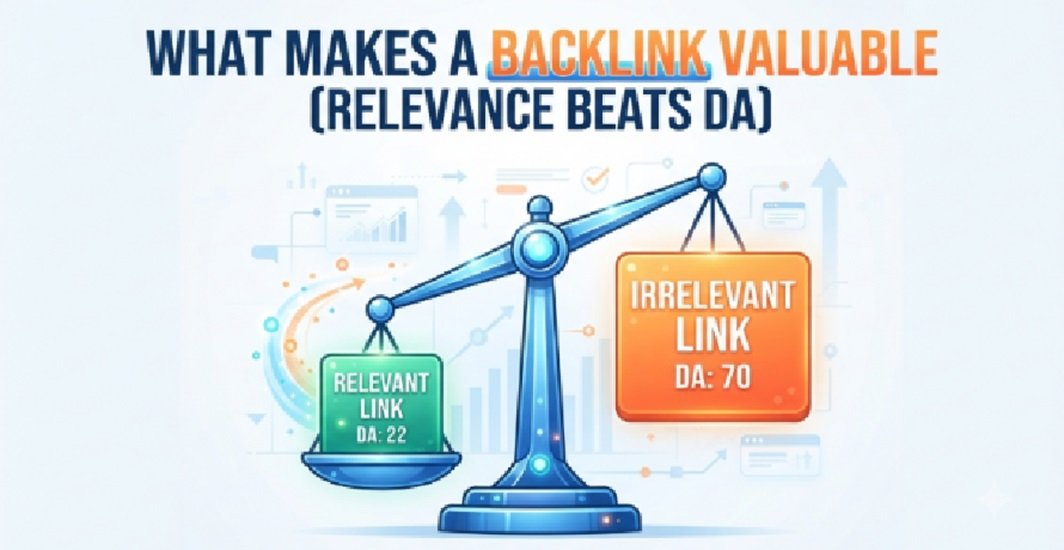
Two links land on your site in the same week. One comes from a DA 78 lifestyle blog that covers everything from celebrity gossip to crypto. The other comes from a DA 24 logistics trade publication whose readers actually buy freight services. If you run a freight forwarding company in Dubai, the second link is almost always worth more, yet most link reports will rank them the other way round.
That gap between what the metrics say and what Google rewards is where most link budgets are wasted. This guide explains how backlink quality is really judged, why link relevance outranks third-party authority scores, and how to evaluate any link before you chase it, pay for it or disavow it.
What Backlink Quality Actually Means
Backlink quality is the likelihood that a link passes genuine trust and relevance signals to your page, and ideally real visitors too. It is not a single number. It is the combined effect of who links to you, where the link sits on their page, what surrounds it and why it exists in the first place.
Google’s own documentation describes links as a way to discover pages and understand how they relate to each other. Its spam policies go further: links created mainly to manipulate rankings are classed as link spam. So the question Google is effectively asking about every link is simple: would this link exist if search engines didn’t?
A link that passes that test, such as an editor citing your research, an industry body listing you as a member or a supplier referencing your case study, carries weight. A link that fails it tends to be ignored at best and treated as a warning sign at worst.
Why Domain Authority Is the Wrong Starting Point
Domain Authority (DA) is a Moz metric scored from 1 to 100. Ahrefs has Domain Rating (DR) and Semrush has Authority Score. All three are handy for comparing sites quickly, and all three share the same limitation: they are not Google metrics, and Google has said publicly that it does not use them.
[H3] DA Estimates a Domain’s Strength, Not a Link’s Value
Third-party authority scores are built largely from the size and strength of a site’s own backlink profile. That makes them a reasonable proxy for “how established is this domain?” but a poor proxy for “will a link from this domain help my page?” A site can have an enormous link profile and no connection to your topic at all.
Where High-DA Links Go Wrong
- Topic mismatch: a general news site linking to an accounting firm from a sponsored “top 10 gadgets” roundup.
- Diluted pages: a link buried on a page with 150 other outbound links, most of them paid.
- Inflated scores: domains that manufactured links to push their DA up so they can sell placements.
- No audience: a high score but organic traffic that has been flat or falling for a year, often a sign that search engines no longer trust the site.
None of these problems show up in a DA number. That is why the metric belongs in the second or third step of any backlink quality review, never the first.
Link Relevance: The Factor That Carries the Most Weight
Link relevance is how closely the linking source matches the subject of the page it points to, and it is the biggest single influence on backlink quality. Google has long used context to interpret links: the anchor text, the words around it and the topic of the linking page all help it understand what the destination is about. A link from a related source confirms your topic. A link from an unrelated one adds noise.
Relevance works on three levels, and the strongest links match on all three.
[H3] Site-Level Relevance
Does the linking website cover your industry, a neighbouring industry or your customers’ world? A property portal linking to a Dubai interior design studio is relevant. A casino review site linking to the same studio is not, however strong its metrics. Relevant links also reinforce the topical authority you build with your own content, because they show Google that other sites in your space see you as part of the conversation.
Page-Level Relevance
This is where many link builders stop checking, and it matters more than site-level fit. A marketing agency’s blog is broadly relevant to an SEO tool, but an article about technical audits is far more relevant than one about office culture. Always judge the individual linking page, not just the homepage.
Surrounding Context and Anchor Text
The sentence around the link should make sense to a reader. Descriptive, natural anchors such as “this guide to schema markup” or “One Conversion’s audit checklist” help Google understand the destination. Exact-match commercial anchors repeated across many sites are one of the patterns Google’s spam policies call out directly.
A quick relevance test: if a reader of the linking page clicked through to your page, would they find what they expected? If yes, the link is relevant. If they would be confused, it isn’t, whatever the DA.
Seven Signals That Determine Backlink Quality
Relevance comes first, but it isn’t the only thing that matters. These are the signals worth checking, roughly in order of importance.
1. Topical Relevance
Covered above. If a link fails here, the rest of the list rarely rescues it.
2. Editorial Intent
Was the link given because someone chose to reference you, or placed because someone paid or traded for it? Editorially earned links are the ones Google’s systems are built to reward. Paid links are acceptable only when they are marked with rel=”sponsored” or rel=”nofollow”, which means they are not meant to pass ranking credit.
3. Real Traffic and a Real Audience
A linking site with steady organic traffic is one search engines still trust. Check traffic trends in Semrush, Ahrefs or Similarweb before you commit. A link that also sends referral visitors has value even if its ranking impact turns out to be modest.
4. Placement on the Page
Links inside the main body content, surrounded by related text, are more likely to be clicked and more likely to be treated as meaningful. Google’s Reasonable Surfer patent describes weighting links by how likely a user is to click them. Footer, sidebar and sitewide blogroll links generally count for less.
5. Natural Anchor Text
A healthy profile is dominated by brand names, bare URLs and descriptive phrases. If most of your anchors are the same keyword phrase, that pattern stands out for the wrong reasons.
6. Link Attributes
Google introduced rel=”sponsored” and rel=”ugc” alongside nofollow in 2019 and treats all three as hints rather than strict directives. A nofollow link from a highly relevant industry source can still bring traffic, visibility and branded searches, so don’t write it off automatically.
7. The Linking Site’s Outbound Links
Look at who else the site links to. If the same page links to payday lenders, essay mills and your business, you are in bad company. Sites that sell links to anyone tend to link to everyone, and that undermines the value of every link they give.
Good vs Bad Backlinks: A Side-by-Side Comparison
Most good vs bad backlinks decisions come down to a handful of tells. Use this table as a quick backlink quality filter before you look at any authority score.
| Factor | Good backlink | Bad backlink |
|---|---|---|
| Relevance | Same or adjacent industry; page topic matches yours | Unrelated niche; generic “write for us” site covering everything |
| Why it exists | Editorial citation, partnership or genuine resource | Unlabelled paid placement, link exchange or private blog network |
| Placement | In the body copy, next to related text | Footer, sitewide blogroll or a list of 100+ links |
| Anchor text | Brand name, URL or descriptive phrase | Repeated exact-match money keyword |
| Linking site traffic | Stable or growing organic traffic | Flat, collapsing or none |
| Outbound links | Selective and relevant | Gambling, pharma and spam links alongside yours |
| Acquisition pattern | Steady, earned over time | Sudden spike from unrelated domains |
A single weak link rarely causes a problem on its own, because Google’s systems are designed to ignore most of them. The risk comes from patterns: a profile built largely on the right-hand column.
Relevant Low-DA vs Irrelevant High-DA: A Worked Example
Take a hypothetical physiotherapy clinic in Abu Dhabi that is offered two links:
- Option A: a DA 70 general “business news” site that accepts paid guest posts on any topic. The article would be “10 Wellness Trends”, published next to posts about forex trading and car rentals.
- Option B: a DA 22 website run by a regional sports physiotherapy group, linking to the clinic’s ACL recovery guide from a member resources page.
On a DA-first spreadsheet, Option A wins easily. On backlink quality, Option B wins clearly: the site is topically aligned, the page covers the exact subject, the audience is the clinic’s audience and the link exists for an editorial reason. Option A also carries risk, because a site selling guest posts on any subject is exactly the kind of source Google’s link spam systems are built to neutralise.
None of this means high-DA sites are bad. A DA 70 health publication linking to the same ACL guide would beat both options. What matters is the order of the questions: relevance first, then authority.
How to Audit Backlink Quality in Five Steps
Whether you are reviewing an existing profile or vetting a new opportunity, the process is the same.
- Export your links. Pull referring domains from the Links report in Google Search Console and from at least one third-party tool such as Ahrefs, Semrush or Moz. Search Console shows a sample of what Google sees; the third-party tools add metrics and history.
- Score link relevance first. Tag each referring domain as relevant, adjacent or unrelated. Then open the linking page itself and check whether its topic matches the page it links to.
- Check site health. Review organic traffic trends, the volume of outbound links and whether the site openly sells posts. Flag anything with collapsing traffic or a prominent “sponsored post” price list.
- Review anchors and placement. Group anchors into brand, URL, descriptive and exact-match. Note any links in footers, widgets or sitewide placements.
- Decide the action. Nurture the strong links by building relationships with those sites. Leave low-value but harmless links alone. Use the disavow tool only for clearly manipulative links that you or a previous agency built, or after a manual action; Google advises that most sites never need it.
For businesses in the UAE, give local relevance extra attention in step two. Links from regional publications, free zone and chamber of commerce directories and UAE industry associations send both topical and geographic signals that generic international sites can’t match.
Why On-Page SEO Decides Whether Links Pay Off
Even strong links underperform when the destination page is weak. A link tells Google a page deserves attention; on-page SEO tells Google what the page is about and whether it deserves to rank. This is where link value and on-page work meet:
- A clear topical focus. A page built around one clear search intent makes relevant incoming links easier for Google to interpret.
- Deliberate internal linking. Authority arriving at one page can support related pages, but only if your internal linking passes it on intentionally.
- Content worth citing. Original data, useful tools and thorough guides earn editorial links on their own, which reduces how much outreach you need.
- Technical access. A page that can’t be crawled and indexed, or that is canonicalised to another URL, wastes every link pointing at it.
That is why we treat link evaluation and on-page optimisation as one conversation at One Conversion. Improving the pages that already attract links is often the fastest way to get more out of the backlink quality you have already earned.
[H2] Common Mistakes When Judging Backlinks
- Filtering by DA alone. A “DA 50+ only” rule confuses popularity with backlink quality and rules out many of the most relevant niche sites in your industry.
- Checking the homepage instead of the linking page. Relevance and placement are page-level properties.
- Treating every nofollow link as worthless. Relevant nofollow links still build visibility, referral traffic and brand demand.
- Panic-disavowing. Links from scraper sites are common and usually ignored. Disavowing good links by mistake causes more damage than the spam ever would.
- Chasing volume. Fifty unrelated links rarely achieve what five genuinely relevant ones can.
- Over-optimising anchors. Asking every partner to use the same keyword anchor creates exactly the pattern you want to avoid.
Quick Backlink Quality Checklist
Before you pursue, pay for or accept a link, run through these questions:
- Is the linking site in my industry or a closely related one?
- Is the specific linking page about a topic related to my target page?
- Would the link exist if search engines didn’t?
- Does the site have real, stable organic traffic?
- Is the link in the main content, with natural text around it?
- Is the anchor text descriptive rather than forced?
- Is any paid relationship marked with rel=”sponsored”?
- Would I be comfortable if a customer saw this link?
If the answer to most of these is yes, the link is worth having, whatever its DA.
FAQs
1. What is backlink quality in SEO?
Backlink quality describes how much trust and relevance a link passes to your page. It depends on the linking site’s topic, the context of the linking page, where the link is placed, the anchor text and whether the link was earned editorially. No single metric captures it.
2. Is Domain Authority a Google ranking factor?
No. Domain Authority is a Moz metric, and Google has stated that it does not use third-party authority scores. DA is useful for comparing websites quickly, but it cannot tell you whether a link is relevant to your business.
Is a low-DA backlink worth getting?
Yes, if it is relevant. A link from a small but focused industry site, local association or niche publication can outperform a high-DA link from an unrelated site, and it usually brings better-qualified visitors.
How can I tell good vs bad backlinks apart?
Check whether the linking site and page match your topic, whether the site has real organic traffic, whether the link sits in the main content with natural anchor text, and whether it looks paid or exchanged. Patterns of unrelated, exact-match or paid links are the clearest warning signs.