You’ve written a great blog post. It’s informative, well-researched, and valuable to your audience. But it’s not ranking. The missing piece? Content optimization SEO the process of refining your content so search engines understand it, users love it, and Google rewards it with higher visibility.
The challenge: optimizing without crossing into keyword stuffing. This guide walks you through exactly how to optimize blog post content naturally, with practical steps you can apply immediately whether you’re writing for a Dubai startup or an Abu Dhabi enterprise.
What Is Content Optimization in SEO?
Content optimization SEO refers to the on-page techniques used to improve a page’s relevance, clarity, and authority so it ranks higher in search results. It’s not about tricking algorithms it’s about making your content easier for both users and search engines to understand.
Content optimization includes:
- Aligning content with search intent
- Using keywords strategically (primary and secondary)
- Optimizing title tags, meta descriptions, and headings
- Improving readability and structure
- Adding internal links and relevant media
- Ensuring mobile-friendliness and fast load times
While SEO content optimization is part of a broader SEO strategy, it focuses specifically on the content itself not technical fixes or backlinks.
Why Content Optimization SEO Matters for UAE Businesses
The UAE digital market is competitive. From Dubai e-commerce stores to Abu Dhabi service providers, businesses are investing heavily in content marketing. Without proper content optimization SEO, even high-quality content gets lost in the noise.
Optimized content helps UAE businesses:
- Rank for location-specific searches (e.g., “content marketing services Dubai”)
- Attract qualified organic traffic
- Build topical authority in competitive niches
- Convert visitors into leads with clearer, more persuasive messaging
For companies working with a content services provider like One Conversion, optimization ensures every piece of content works harder driving visibility and ROI.
The Keyword Stuffing Problem (And How to Avoid It)
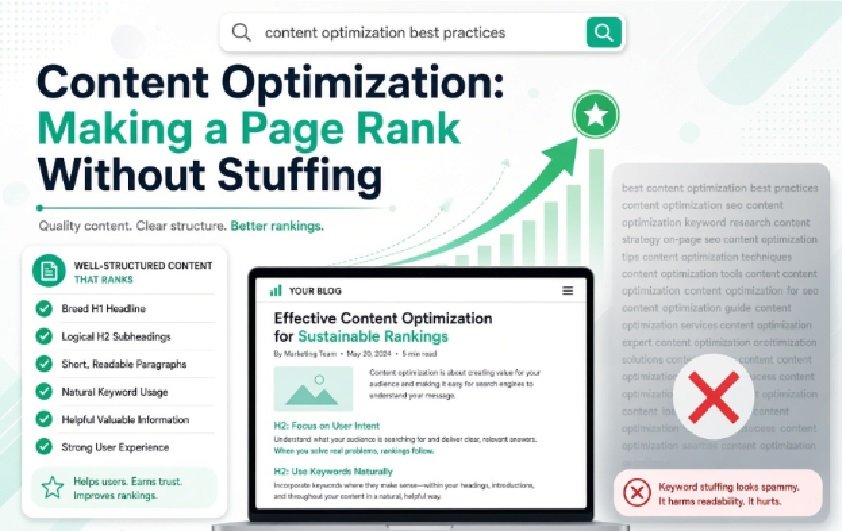
Keyword stuffing overusing exact-match keywords in an attempt to manipulate rankings is one of the fastest ways to hurt your SEO. Google’s algorithms now detect unnatural repetition and may penalize pages that prioritize keywords over readability.
What Keyword Stuffing Looks Like
Stuffing isn’t just repeating a keyword 50 times. It also includes:
- Forcing keywords into every heading
- Using awkward phrasing to fit exact-match terms
- Repeating the same keyword in consecutive sentences
- Adding irrelevant keywords just to target more searches
Example of stuffing:
“Our content optimization SEO services provide the best content optimization SEO for your business. With content optimization SEO, you get content optimization SEO results that improve your content optimization SEO rankings.”
This reads unnaturally and signals low-quality content to both users and Google.
Why Google Penalizes Stuffing
Google’s goal is to surface helpful, user-first content. Keyword stuffing degrades user experience by making content harder to read and less trustworthy. Pages that stuff keywords often:
- Rank lower (or get de-indexed)
- Have higher bounce rates
- Fail to convert visitors
The solution? Use keywords strategically enough to signal relevance, but not so much that readability suffers.
Step-by-Step: How to Optimize Content for SEO Naturally
Here’s a practical workflow to optimize blog post content without stuffing.
1. Start With Search Intent
Before writing, identify what users actually want when they search your target keyword. For “content optimization SEO,” users likely want:
- A clear definition
- Actionable steps to optimize their own content
- Examples of good vs. bad optimization
- Tools or services that can help
Match your content to this intent. Don’t write a sales page when users want a guide.
2. Map Your Primary and Secondary Keywords
Identify:
- Primary keyword: content optimization SEO (use 10–12 times naturally)
- Secondary keywords: SEO content optimization, optimize blog post (use throughout)
- Semantic terms: on-page SEO, keyword usage, search intent, meta tags, readability, UAE content marketing
Create a keyword map before writing. This prevents overuse and ensures natural distribution.
3. Optimize Your Title and Meta Description
Your title tag and meta description are critical for click-through rates. Include your primary keyword once in each, but write for humans first.
Example:
- Title: Content Optimization SEO: How to Rank Without Keyword Stuffing
- Meta Description: Learn content optimization SEO techniques that help your pages rank higher without stuffing. Practical steps for UAE businesses to optimize blog posts naturally.
4. Structure Content With Clear Headings
Use a logical heading hierarchy:
- One H1 (your page title)
- H2s for main sections
- H3s for subsections
Include keywords in headings where they fit naturally not in every heading. For example:
- H2: Why Content Optimization SEO Matters for UAE Businesses ✓
- H2: Common Content Optimization SEO Mistakes to Avoid ✓
- H2: How Our Team Works ✓ (no keyword needed)
5. Use Keywords Strategically (Not Everywhere)
Place your primary keyword in:
- The H1
- The first 100–150 words
- 2–3 H2 headings (where relevant)
- The conclusion
- Image alt text (if applicable)
- Meta title and description
Use secondary keywords and variations throughout the body. Aim for natural flow if a sentence sounds awkward with the keyword, rephrase or omit it.
Target frequency:
- Primary keyword: 10–12 times in a 2,000-word article
- Secondary keywords: 5–8 times each
- Semantic variations: as needed for clarity
6. Improve Readability and Scannability
Google favors content that’s easy to read. Improve readability by:
- Using short paragraphs (2–4 sentences)
- Breaking up text with bullet points and numbered lists
- Writing in active voice
- Avoiding jargon unless your audience expects it
- Using transition words (however, therefore, for example)
Tools like Hemingway or Yoast can help assess readability scores.
7. Add Internal and External Links
Internal links help search engines crawl your site and signal topical relevance. Link to:
- Related blog posts
- Service pages
- Pillar content or guides
External links to authoritative sources (e.g., Google’s SEO guidelines, industry studies) add credibility.
8. Optimize Images and Media
Images improve engagement but need optimization:
- Compress file sizes for faster loading
- Use descriptive file names (e.g., content-optimization-checklist.jpg)
- Add alt text with relevant keywords (e.g., “Content optimization SEO checklist for UAE businesses”)
SEO Content Optimization Checklist for Blog Posts
- ☐ Primary keyword in H1, title tag, meta description, and first paragraph
- ☐ 10–12 natural uses of primary keyword throughout
- ☐ Secondary keywords integrated without forcing
- ☐ Headings follow H1 → H2 → H3 hierarchy
- ☐ Content matches search intent
- ☐ Paragraphs are short and scannable
- ☐ Internal links to relevant pages
- ☐ External links to authoritative sources
- ☐ Images optimized with alt text
- ☐ Meta title under 60 characters
- ☐ Meta description under 160 characters
- ☐ URL slug is clean and keyword-inclusive
- ☐ Mobile-friendly and fast-loading
Common Content Optimization Mistakes to Avoid
1. Over-optimizing anchor text
Using exact-match keywords for every internal link looks spammy. Vary your anchor text (e.g., “learn more,” “our guide,” “content services”).
2. Ignoring search intent
Writing a product page when users want a how-to guide leads to high bounce rates and poor rankings.
3. Skipping the refinement stage
First drafts rarely achieve optimal keyword distribution. Edit specifically for natural keyword flow.
4. Forgetting local context
For UAE businesses, omitting location-specific references (Dubai, Abu Dhabi, UAE market) misses local SEO opportunities.
5. Treating optimization as a one-time task
Content needs periodic updates to stay relevant. Re-optimize older posts with new keywords, data, or examples.
When to Work With a Content Optimization Service
Not every business has the time or expertise to optimize content in-house. Working with a content services provider like One Conversion makes sense when:
- You’re producing content at scale (multiple posts per month)
- Your current content isn’t ranking despite quality writing
- You need UAE-specific optimization expertise
- You want a consistent, repeatable optimization workflow
Professional SEO content optimization services ensure every piece of content is structured, keyword-mapped, and refined for maximum impact without stuffing.