Most schema markup conversations begin with a list of types. That is the wrong place to start. The useful question is: “What can this specific page truthfully describe, and does Google support a search feature for it?”
For technical SEO teams, schema markup is best treated as a data-quality and eligibility layer. It gives search engines explicit information about the page, but it does not manufacture relevance, override weak content, or guarantee a richer result. Google says structured data can help it understand a page and can make a page eligible for rich results; it also makes clear that eligibility is not a promise of display.
The short answer: use markup that matches a real page and a supported feature
The schema markup types that tend to matter most are the ones that map to a genuine, user-visible page type and a Google-supported result feature. For many sites, that means Product or merchant listing markup for purchasable items, LocalBusiness for an actual business location, Article for editorial content, BreadcrumbList for site hierarchy, VideoObject for a primary video, Event for real events, and JobPosting for genuine vacancies.
Start with the page template that has the clearest commercial or discovery value. A retailer should normally prioritise product pages before a generic WebPage type. A multi-location UAE business should clean up location data before attempting niche markup. A publisher should make article metadata consistent before adding decorative entities to every page.
The principle is simple: implement the most specific type that accurately represents the page, populate its important properties from reliable source data, and maintain it. Google’s own guidelines recommend using the most specific applicable types and properties.
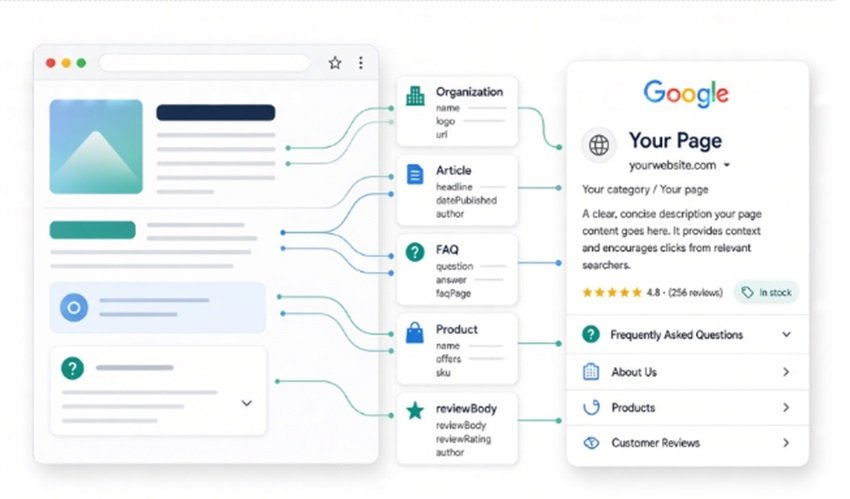
Schema markup is machine-readable data, usually using the Schema.org vocabulary, placed on a page to identify the entities and attributes it contains. On a product page, for example, that could include the product name, image, price, availability, brand, and offers. This is a form of structured data SEO : it reduces ambiguity about what the content means.
Schema.org vocabulary versus Google Search features
Schema.org is a broad vocabulary. Google Search supports a defined set of structured-data features for enhanced appearances, such as Article, Product, LocalBusiness, Breadcrumb, Event, JobPosting, Recipe, Video, and others. A type can be valid Schema.org without being a Google rich-result feature. That does not make it useless, but it changes the business case: use it for truthful entity description or interoperability, not because you expect a visible SERP treatment.
This distinction prevents a common mistake: treating every valid schema markup object as an SEO win. First check Google’s Search Gallery and the documentation for the exact type. Then confirm that the page has the visible information and required properties that feature needs.
Why JSON-LD is the practical default
For most teams, JSON-LD schema Is the best implementation format. It sits in a script block rather than being woven through the HTML, which makes complex relationships easier to express and reduces template-editing risk. Google recommends JSON-LD in most cases because it is generally easier to implement and maintain at scale, although Microdata and RDFa are also supported when valid.
That does not mean a plugin-generated block is automatically correct. The source data behind the JSON-LD schema must remain aligned with the rendered page. If a price, stock state, opening hour, author, or FAQ answer changes on the page, the structured data needs to change with it.
Which schema types are worth prioritising?
Prioritise schema markup by page purpose and operational readiness, not popularity. The table below is a practical starting point.
| Page situation | Priority markup | Why it can do something | Key caution |
| Individual product pages with price and availability | Product / merchant listing | Can help Google interpret offers and product attributes; product-related Search features have specific requirements. | Only mark up real, current offers and visible product facts. |
| A real office, shop, clinic, or service location | LocalBusiness plus Organisation where appropriate | Clarifies business identity, contact details, address, and hours; useful for local entity consistency. | Do not create fictitious locations or mark up a service area as a staffed address. |
| Editorial article or blog post | Article or BlogPosting | Supports clearer article metadata and can be relevant to article-related Search appearances. | Use accurate headline, author, dates, and image data that reflect the page. |
| Pages with a clear hierarchical path | BreadcrumbList | Can express navigational hierarchy. | Use the actual user-accessible path, not a fabricated taxonomy. |
| Pages primarily centred on a crawlable video | VideoObject | Can help communicate video details and eligibility for video-related appearances. | The video must be a genuine, accessible focus of the page. |
| Time-bound public event pages | Event | Can identify dates, venue, attendance and ticket information. | Remove or update cancelled and past event data. |
| Dedicated vacancy pages | JobPosting | Can support Google’s job-search experience when all policies are met. | Use only genuine, active roles and keep expiry data current. |
First priority: product and merchant listing markup
If a site sells identifiable products, Product and merchant listing schema markup often belong at the top of the backlog. The page must contain the product and offer information users need, and the markup must carry the same truth: no speculative availability, invented ratings, or prices that differ from checkout reality. Google lists Product among its supported structured-data features and documents merchant listings separately.
A sensible implementation is template-driven: product information should come from the same catalogue fields that render the visible name, image, price, currency, availability, brand, GTIN where available, and canonical URL. This protects structured data SEO from silent drift between the feed, page, and markup.
First priority: local business and organisation markup
For UAE companies with premises customers can visit or contact, LocalBusiness and Organisation schema markup an clarify identity: legal or trading name, logo, address, telephone, opening hours, and sameAs profiles where appropriate. It is especially valuable when business details are fragmented across location pages, Google Business Profile, footer templates, and social profiles.
Use the more specific LocalBusiness subtype only when it is accurate. An agency with one Dubai office should describe the real office rather than publish a separate LocalBusiness object for every emirate it serves. This is entity hygiene, not a shortcut to local rankings. Google’s guidelines require structured data to be a truthful representation of the page and prohibit misleading content.
Strong conditional choices: article, breadcrumb, video, event and job posting
Article schema markup is appropriate for this kind of guide because the page is an editorial article. Breadcrumb markup is often a low-risk complement where the site has a stable, visible hierarchy. VideoObject makes sense when the page has a primary video with complete metadata. Event and JobPosting should be restricted to pages that are genuinely about a single event or active role. Google’s supported-feature gallery is the reference point for deciding whether a page type has a relevant Search feature. [web:6]
These types are conditional, not mandatory. A blog post with a minor embedded video is not automatically a video landing page. A careers hub is not automatically a JobPosting. The best json-ld schema mirrors page intent rather than attempting to claim every possible entity.
Use only where earned: review, recipe, course and other specialised markup
Specialised types work well when the page is genuinely specialised. Recipes need recipe content; courses need a real course list and provider details; review markup requires authentic, visible review information and must comply with the relevant policies. Avoid copying a generic review block to service pages just to chase stars. Google specifically warns against markup for content that is hidden, irrelevant, misleading, or not original.
FAQPage deserves particular restraint. It can accurately describe visible FAQs, but it should not be used to duplicate sales copy or pad a page with thin questions. It is a content representation choice—not a promise of an FAQ-rich result.
A schema markup decision framework for technical SEOs
Use this five-question screen before creating or expanding schema markup.
- 1. What is the page’s main entity or purpose? Choose the most specific truthful type.
- 2. Is there a Google-supported feature that applies to this page type? Check the Search Gallery and the feature documentation.
- 3. Can the page supply every required field and meaningful recommended fields from reliable source data?
- 4. Is each marked-up claim visible to users, accurate, current, and accessible to Google?
- 5. Can the implementation be maintained across templates, migrations, price updates, editorial changes, and retirements?
If the answer to the final three questions is no, defer the work. A smaller set of complete schema markup objects is safer and more useful than a large collection of brittle, partial annotations. Google likewise advises prioritising complete and accurate data over trying to provide every property with poorly formed or inaccurate values.
How to implement JSON-LD without creating a maintenance problem
Build the entity model before writing code
Begin with the visible template and the systems that supply its data. Define the primary entity, its canonical URL, its stable identifier, and its relationships. For a product, connect Product to Offer. For an article, connect the article to its publisher, author, image, and dates. For a location page, connect the business to its address, telephone, opening hours, and parent organisation where relevant.
Then generate JSON-LD schema from those source fields rather than hand-editing hundreds of pages. Use `@id` consistently when different objects describe the same entity. This makes the markup more maintainable and helps avoid conflicting duplicate blocks produced by themes, SEO plugins, ecommerce apps, and tag managers.
Validate, deploy, and monitor
A robust schema markup release process has four steps:
- 1. Validate representative URLs in Google’s Rich Results Test to identify feature eligibility and implementation errors.
- 2. Use the Schema Markup Validator when you need generic Schema.org validation beyond Google-specific features.
- 3. Inspect rendered source and use Search Console URL Inspection to confirm Google can fetch the page and see the structured data.
- 4. Monitor the relevant Search Console enhancement report and page-level performance after deployment; investigate changes after template releases, catalogue updates, or CMS migrations.
Google recommends the Rich Results Test for eligible rich-result features and the Schema Markup Validator for generic Schema.org validation. It also advises checking deployed pages with URL Inspection and monitoring after launch.
Common schema markup mistakes
- Using a generic type when a more specific, accurate type is available.
- Marking up claims that do not appear to users, including old prices, invisible reviews, or generic FAQ answers.
- Assuming a passing test guarantees a rich result. It does not.
- Adding every type a plugin offers, creating duplicate or contradictory entities.
- Leaving event dates, availability, opening hours, job postings, or author details stale.
- Deploying JSON-LD only on canonical URLs while equivalent live duplicate URLs show a different page state.
- Treating generated markup as finished work and never checking Search Console after launch.
The first three are especially costly. A page can be syntactically valid yet still be ineligible or not displayed if it fails quality requirements, is inaccessible, or is not representative of its visible content. [web:3]
How to measure whether structured data SEO is working
Do not measure structured data SEO by the presence of code alone. Track validity first, then visibility, then business outcomes. In Search Console, review the relevant enhancement reports for errors, warnings, and valid items. Use URL Inspection for representative templates. In performance reporting, compare stable page cohorts before and after implementation while accounting for seasonality, promotions, rankings, and site changes.
Google recommends a before-and-after comparison using pages with enough historical data, validation through URL Inspection, and several months of performance data where possible. Treat click-through-rate changes as an outcome to investigate, not proof that markup alone caused the movement. [web:2]
The strongest result is operational: a crawlable page with accurate content, clean data, a supported page type, valid markup, and measurable search visibility. That is what “doing something” looks like—not a schema generator output or a promised SERP enhancement.
FAQs
1) What is schema markup in SEO?
Schema markup is structured data, commonly based on the Schema.org vocabulary, that gives search engines explicit information about the content and entities on a page. It can help a page become eligible for supported rich-result features when the implementation and page meet Google’s requirements.
2) Does schema markup directly improve rankings?
No. Schema markup is not a direct ranking switch. It can help search engines understand page content and may make a page eligible for richer search appearances, but Google does not guarantee that those appearances will show.
3) Which schema markup types should I implement first?
Start with the most specific markup that matches high-value, user-visible page templates: typically Product or merchant listing for ecommerce, LocalBusiness for real locations, Article for editorial content, and BreadcrumbList for a clear hierarchy. Add Video, Event, or JobPosting only when those pages genuinely exist.
4) Is JSON-LD better than Microdata?
Google supports JSON-LD, Microdata, and RDFa when implemented correctly. JSON-LD is usually the practical default because it is easier to implement and maintain separately from the page HTML.
5) Can valid schema markup guarantee rich results?
No. Valid markup makes a page eligible where a supported feature applies, but Google decides how results appear based on many factors. The page must also meet content, technical, and type-specific guidelines.