A marketing plan becomes easier to manage when every campaign has a clear job. Some campaigns introduce a problem to people who have not considered a solution. Others help an interested prospect compare options. The final group removes friction when someone is ready to act. The marketing funnel is a practical way to organise those different moments across the buyer journey.
What Is a Marketing Funnel?
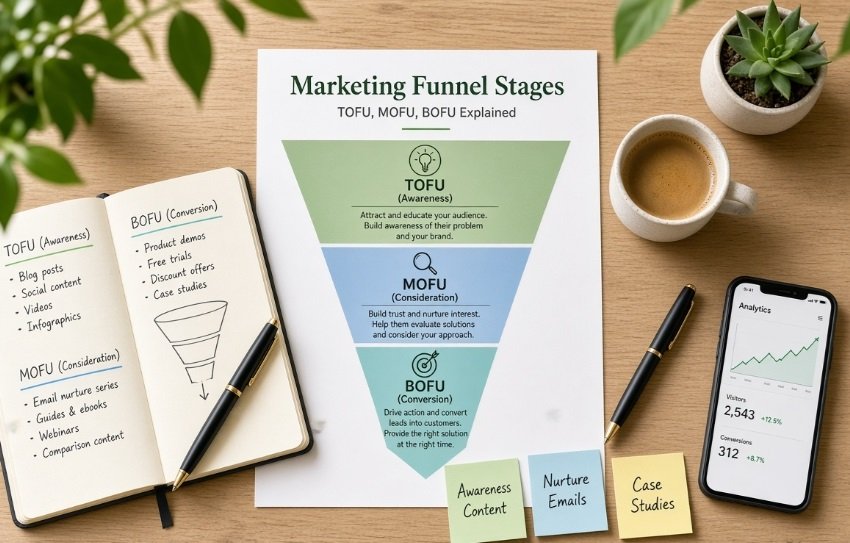
A marketing funnel is a model that describes how people move from initial awareness of a problem, brand or solution toward a purchase or another meaningful conversion. The classic framework is divided into three stages: TOFU, MOFU and BOFU. TOFU means top of funnel, MOFU means middle of funnel, and BOFU means bottom of funnel.
The important point is not the shape of the diagram. It is the change in buyer intent. A person discovering a problem needs a different message from someone comparing providers. A prospect who is already evaluating an offer may need proof, pricing information or a direct next step rather than another introductory article.
The funnel should therefore be treated as a planning framework, not a rigid sequence that every person follows in exactly the same way. Current marketing guidance also describes it as a diagnostic model for understanding where friction occurs in the journey.
The Three Marketing Funnel Stages at a Glance
| Stage | Buyer mindset | Primary job | Typical content | Useful metrics |
| TOFU | I have a problem or question. | Create awareness and attract relevant people. | Educational articles, guides, videos, social content | Reach, traffic, engagement, new visitors, sign-ups |
| MOFU | I am evaluating possible solutions. | Build understanding and trust. | Comparisons, webinars, case-style content, detailed guides, email nurture | Engaged leads, content engagement, qualified leads, demo requests |
| BOFU | I am ready to choose. | Reduce final friction and drive action. | Pricing, demos, consultations, product/service pages, proof | Conversions, opportunities, close rate, cost per acquisition |
This TOFU-MOFU-BOFU structure is consistent across current search results, although some publishers use four or five stages by separating retention, loyalty or advocacy.
TOFU: The Awareness Stage
TOFU is where the audience is furthest from a purchase decision. They may recognise a business problem, be researching a topic or simply be looking for an answer. The goal is not to force a sale; it is to become useful at the moment the problem is being explored.
What TOFU is trying to achieve
A strong TOFU plan attracts people who are relevant to the business, not just large volumes of traffic. For example, a marketing consultancy could publish an educational guide explaining how to identify weak acquisition channels. Someone searching for that information may not be ready to book a consultation, but the topic establishes relevance and creates a logical path to deeper content.
Content that fits TOFU
- Educational blog posts that answer broad but commercially relevant questions.
- Beginner-friendly guides and checklists.
- Explainer videos or social posts that simplify a genuine problem.
- Research-led or educational resources that help a prospect understand the issue.
The CTA should usually be proportional to the buyer’s intent. Asking a cold visitor for a major commitment can create unnecessary friction. A useful next step might be a related guide, newsletter subscription or deeper educational resource.
How to measure TOFU
Measure whether the content attracts the right audience and creates meaningful engagement. Traffic, impressions, engaged sessions, new visitors and sign-ups can help show whether awareness activity is reaching people. The exact metric mix should reflect the channel and business model rather than a universal benchmark.
MOFU: The Consideration Stage
MOFU is where the prospect knows more about the problem and begins evaluating ways to solve it. This is the stage where generic education becomes less useful and specificity becomes more valuable. The prospect may be comparing approaches, providers, features, costs or implementation requirements.
What MOFU is trying to achieve
The objective is to help a prospect move from interest to informed evaluation. That means answering the questions that appear after the basic problem is understood: Which approach fits? What are the trade-offs? What should a buyer look for? What evidence supports the decision?
Content that fits MOFU
- Detailed guides that explain approaches and decision criteria.
- Comparison content that makes meaningful differences clear.
- Webinars, workshops or educational sessions.
- Case-style examples where genuine evidence is available.
- Email nurture content that responds to known interests.
MOFU content should also anticipate objections. If a buyer is likely to worry about implementation time, integration, cost or internal resources, those concerns should be addressed directly rather than hidden behind broad brand messaging.
How to measure MOFU
Look for evidence of deeper engagement: return visits, content consumption, qualified lead actions, consultation requests, webinar participation or movement into a sales process. A high number of leads with little progression can indicate that acquisition is working while consideration-stage messaging is not doing enough to qualify or educate.
BOFU: The Decision and Conversion Stage
BOFU is the point where a prospect is close enough to a decision that the practical details matter. They may already know the category and have shortlisted options. The job now is to make the next step clear and reduce avoidable friction.
What BOFU is trying to achieve
BOFU content should answer the final questions that prevent action. Depending on the business, those questions may involve pricing, scope, process, availability, proof, implementation, timelines, service details or what happens after the first contact.
Content that fits BOFU
- Service or product pages with clear value and next steps.
- Pricing or package information where appropriate.
- Consultation, demo or contact pages.
- Decision-focused comparisons.
- Customer proof, testimonials or case studies when genuine and permitted.
The CTA should be direct, but clarity matters more than pressure. A prospect should know what happens after clicking, submitting a form, booking a call or requesting information.
How to measure BOFU
Measure actions tied closely to commercial outcomes: qualified opportunities, conversion rate, booked consultations, purchases, close rate, acquisition cost and time to close. These metrics help show whether the final stage is converting the demand created earlier.
TOFU vs MOFU vs BOFU: What Changes Between Stages?
The main difference is the question the buyer is trying to answer. TOFU answers, “What is this problem and why does it matter?” MOFU answers, “Which solution or approach should I consider?” BOFU answers, “Which option should I choose, and what do I need to do next?”
| Dimension | TOFU | MOFU | BOFU |
| Intent | Exploring | Evaluating | Deciding |
| Message | Educate | Clarify and build trust | Prove and reduce friction |
| CTA | Low commitment | Engagement or evaluation | Direct conversion |
| Content depth | Broad and accessible | Specific and comparative | Detailed and decision-focused |
| Primary question | What is the problem? | What is the right solution? | Why should I choose this option? |
This distinction prevents a common planning mistake: using the same message for every audience. Current guides repeatedly emphasise matching content and calls to action to the prospect’s stage rather than treating every visitor as equally ready to buy.
How to Build a Practical Funnel for a Marketing Team
Start with buyer questions
- List the questions a prospect asks before they know your brand.
- Group those questions into awareness, evaluation and decision intent.
- Identify the content that can answer each group without repeating another asset.
- Assign a logical next step so a visitor can move deeper when their intent increases.
- Choose stage-appropriate metrics and review where prospects stop progressing.
Assign content and CTAs to intent
A simple content map can prevent random publishing. If a topic attracts early-stage searchers, its CTA should usually lead to another educational step. If a page attracts prospects who are comparing providers, the CTA can move toward a consultation, demo or detailed service explanation. BOFU pages should make the conversion path especially clear.
Track stage-to-stage movement
Do not judge the entire funnel from one number. A campaign can generate strong awareness while producing weak consideration, or generate many leads while producing few qualified opportunities. The useful question is where the drop occurs and what changed at that stage.
Common Marketing Funnel Mistakes
- Treating traffic volume as the same thing as business impact.
- Publishing only TOFU content and expecting it to create immediate sales.
- Sending high-pressure BOFU CTAs to people who are still learning.
- Creating MOFU content without addressing real comparison questions.
- Tracking leads without checking lead quality or progression.
- Building disconnected campaigns that do not provide a logical next step.
- Assuming every buyer follows the same path in the same order.
A useful funnel is not defined by having more stages or more content. It is defined by whether the content, CTA and measurement fit the buyer’s current intent.
Marketing Funnel vs Sales Funnel
A marketing funnel generally focuses on how audiences move from awareness into consideration and conversion. A sales funnel is more closely associated with the sales process after a prospect enters a pipeline, such as qualification, proposal, negotiation and close. The two systems overlap, but they are not identical.
For a marketing team, the practical priority is alignment. Marketing should make it clear what actions indicate increasing intent, while sales should know what information and expectations have already been established. This reduces duplicated conversations and makes handoffs easier to diagnose.
How the Funnel Works as One System
The three stages should not operate as separate content buckets. TOFU creates relevant attention, MOFU gives that audience reasons to continue evaluating, and BOFU makes the final action easier. When one stage is missing, the experience can become uneven: a brand may attract attention without building enough trust, or generate qualified interest without providing enough decision support.
For UAE marketing teams, the same principle applies across industries: start with the audience’s actual questions, create content that matches those questions, and connect each asset to the next logical step. Avoid adding location references simply for SEO; include UAE-specific context only where it changes the buyer’s question, process or decision.
The strongest marketing funnel is therefore not the one with the most campaigns. It is the one where every stage has a clear purpose, the audience receives the right level of information, and the team can identify where prospects progress or stall. When marketing funnel are mapped this way, TOFU, MOFU and BOFU become a working system rather than a set of marketing abbreviations.
FAQs
1. What do TOFU, MOFU and BOFU mean?
TOFU means top of funnel and represents awareness. MOFU means middle of funnel and represents consideration. BOFU means bottom of funnel and represents the decision or conversion stage.
2. What are the main marketing funnel stages?
The classic three-stage model is awareness, consideration and conversion, commonly described as TOFU, MOFU and BOFU. Some models add retention or advocacy after conversion.
3. What content works best for TOFU?
Educational content such as introductory guides, explanatory articles, checklists and broad problem-solving resources is commonly used at TOFU because the audience is still learning.
4. What is the difference between MOFU and BOFU?
MOFU helps prospects evaluate solutions and build confidence. BOFU addresses final decision questions and makes the conversion step clear.
5. How do you measure a marketing funnel ?
Use stage-appropriate metrics. TOFU can focus on reach and relevant traffic, MOFU on engagement and qualified lead actions, and BOFU on conversions, opportunities, close rate and acquisition cost.